
Investing in Real Estate in Dubai: A Strategic Approach with Professional Guidance
Real estate investment in Dubai refers to the process of purchasing property assets in the city to generate financial returns. Real estate investors typically realize these returns through rental income, capital appreciation, or a strategic combination of both. Due to the city’s tax-free environment, strong potential for capital growth, and high rental demand, Dubai is one of the most attractive and well-established property investment destinations globally. Continuous infrastructure development further strengthens its position as a leading hub for international capital.
In this guide, we will explore the different aspects of investing in Dubai’s real estate market, including types of property investment, investment strategies, steps, and more. Furthermore, if you are planning to invest in Dubai’s property market but are unsure which direction to take, feel free to contact me. As an advisor at fäm Properties, I, Siraj Sultanli (RERA License No. 93112), would be glad to support you with professional guidance throughout the entire investment process.
Why Dubai Attracts International Real Estate Investors
To understand the specifics of real estate investment in Dubai, it is important to first examine why international investors choose the city.
Below are some of the key reasons why international investors prefer Dubai for property investment:
- No annual property tax or capital gains tax
- No inheritance or rental income tax
- High rental yields (typically 6–9%)
- Strong capital appreciation potential
- Stable and regulated investment environment
- Continuous infrastructure development
- Golden Visa opportunities through property investment
- Strategic global location connecting Europe, Asia, and Africa
- Strong population growth driven by expatriates and professionals
- Premium lifestyle and global city positioning
These factors create a strong foundation for long-term property investment in Dubai. However, every investor has different goals. Therefore, the strategy must always align with the investment objective.
Main Types of Property Investment in Dubai
Dubai is not yet a fully matured city like New York or London, which are established global investment hubs. We can say that across the city, new residential communities are launched every year. As a result, the market has its own investment models that differentiate it from other global markets.
Therefore, Dubai’s real estate market generally includes two main property investment models:
- Ready Property Investment – Investment in completed and handover-ready units
- Off-Plan Property Investment – Investment in pre-construction or under-construction properties
Understanding these investment models is essential before investing. A clear understanding of Dubai’s market specifics can help investors make more strategic investment decisions.
Off-Plan Property Investment in Dubai
Off-plan properties in Dubai refer to real estate units purchased before completion—sometimes even before construction begins. Therefore, investors buy based on project plans, designs, master plans, and developer commitments. In this model, real estate investors typically pay the property value in installments according to an agreed payment plan.
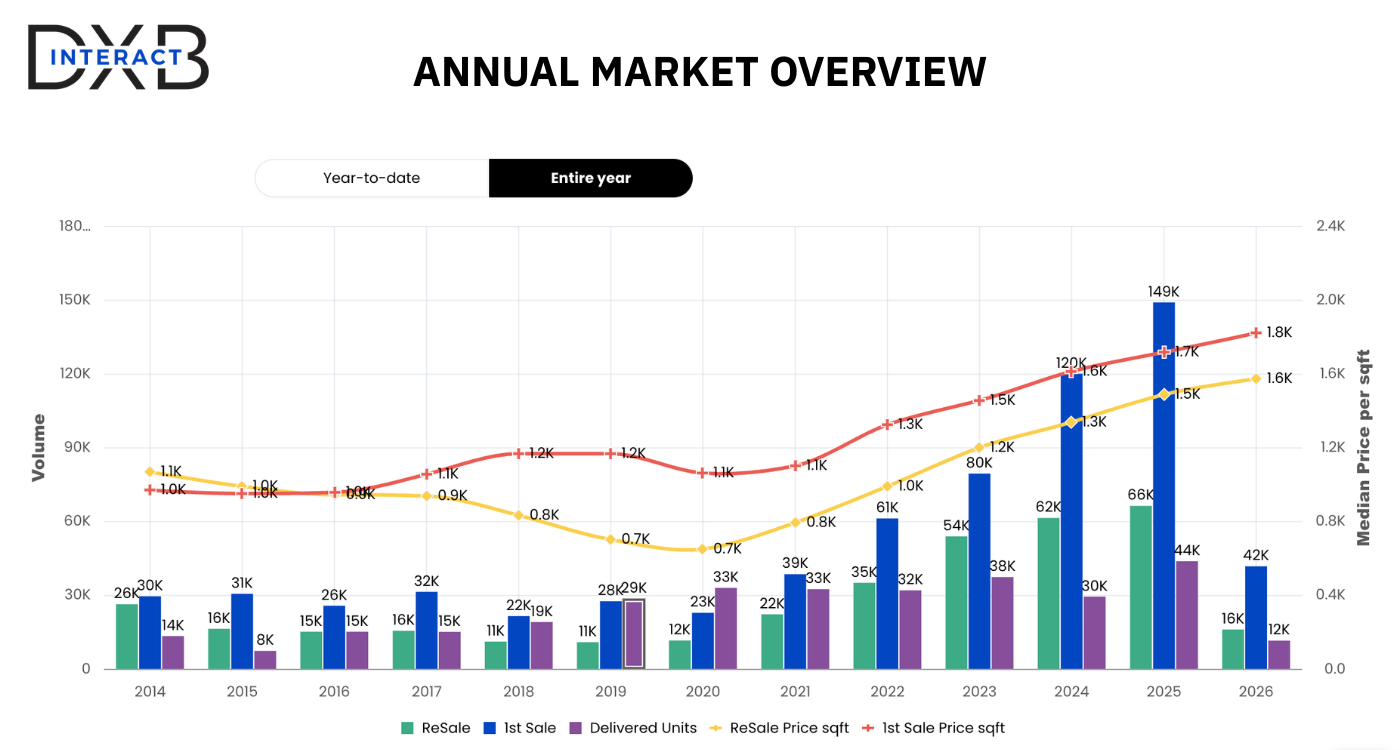
Off-Plan investment model is one of the key pillars of Dubai’s real estate market. For example, while ready property transactions totaled around 66,000 in 2025, off-plan units reached approximately 149,000 in the same year. Similarly, in the first quarter of 2026, around 16,000 ready units were sold, compared to approximately 42,000 off-plan transactions (Source: DXB Interact).
Many of today’s iconic areas, such as Downtown Dubai, Palm Jumeirah, and Dubai Creek Harbour, started as off-plan developments.
Advantages of Off-Plan Investment:
- Lower entry prices compared to ready properties
- Flexible developer payment plans
- Higher potential for capital appreciation
- Access to new and developing communities
Who Should Invest in Off-Plan Properties?
- Investors seeking medium- to long-term growth
- Buyers preferring installment-based payments
- Investors planning resale (flipping) strategies
- Those targeting maximum capital appreciation
👉 However, not every off-plan project performs the same. Selection, timing, developer choice, and an understanding of the city’s master planning are critical. For example, you may choose a strong developer and a good location, but if the timing is not right, you may not be able to maximize your investment returns.
Ready Property Investment in Dubai
Ready properties are completed units that can be purchased, used, or rented immediately. Some investors prefer this type of property over off-plan investments.
This model is more straightforward and typically offers faster returns compared to off-plan investment models.
Advantages of Ready Properties
- Lower uncertainty
- Immediate rental income
- Ability to physically inspect the property before purchase
- Clear visibility of the community and infrastructure
Who Should Invest in Ready Properties?
- Investors seeking rental income
- End-users planning to live in Dubai
- Buyers preferring stable and predictable returns
Property Investment Strategies in Dubai
In any investment, success largely depends on strategy—and the same applies to Dubai’s real estate market. To invest effectively, it is important to choose a strategy that aligns with your investment goals.
The three most common property investment strategies in Dubai are:
- Strategic Resale Strategy (Flipping)
- Rental Income Strategy
- Hybrid Strategy
Strategic Resale Strategy (Flipping)
As mentioned earlier, Dubai is not yet a fully matured city and continues to grow, with new communities being launched regularly. Therefore, investors who enter the right off-plan communities at an early stage can benefit from maximum capital appreciation.
This approach is typically a mid-term strategy (3–5 years). However, it is important to note that timing and selecting the right community are critical to maximizing investment returns.
Rental Income Strategy
In this strategy, the approach is more straightforward: the investor selects the right project and unit based on the highest potential rental yield and invests accordingly. Notably, Dubai offers attractive rental yields compared to global markets, typically ranging from 6% to 10%. It is also worth noting that rental income in Dubai is tax-free.
This strategy is most suitable for investors seeking immediate and predictable returns.
Hybrid Strategy
The hybrid strategy combines both capital appreciation and rental income within a single investment approach. Investors may enter early (often off-plan) and, after completion, instead of reselling, hold the property and rent it out.
Real Estate Financing Options in Dubai
Buying property in Dubai is not limited to cash buyers. Moreover, developer payment plans are not the only financing option available to investors. Therefore, both UAE residents and non-residents can access mortgage financing through local banks, with interest rates typically around 3.5%–4.5% per year.
Bank Financing:
- For residents: Up to 80% of the property value
- For non-residents: Up to 50% of the property value
👉 Note: Financing terms and requirements may vary depending on the bank and the individual applicant’s profile.
Step-by-Step Guide to Property Investment in Dubai
To complete a property investment (purchase) in Dubai, you need to follow these steps:
Step 1: Define Your Investment Goal
- Rental income
- Capital appreciation
- Long-term holding
Step 2: Conduct Market Research
- Select the right location
- Analyze the property or project
- Evaluate the developer’s reputation
Step 3: Reserve the Property
- For off-plan properties: Sign the SPA (Sales and Purchase Agreement)
- For ready properties: Sign Form F (Memorandum of Understanding)
Step 4: Registration (Transfer) Process
- For off-plan properties: Register Oqood (pre-title deed)
- For ready properties: Complete title deed transfer through Dubai Land Department
Step 5: Post-Purchase Actions
- For off-plan properties: Follow the payment plan and take handover upon project completion
- For ready properties: Rent out the property or hold it for future appreciation
Which Areas to Invest in Dubai in 2026
Choosing the right location is one of the most important parts of achieving your investment goals. In reality, it’s not just about following popular areas; rather, it’s about selecting a location that truly fits your strategy.
Depending on your goals, you may consider the following:
- Established areas (stable rental demand): Dubai Marina, Downtown Dubai, etc.
- Emerging areas (higher growth potential): Palm Jebel Ali, Dubai South, Dubai Islands, The Oasis by Emaar, etc.
- Master-planned communities: Dubai Hills Estate, Dubai Creek Harbour, etc.
👉 However, it is important to note: These are just general examples. Ultimately, the right area depends on your personal investment goals, and in many cases, other locations may be even more suitable.
Dubai Real Estate Market Performance in Q1 2026
Dubai’s real estate market continued to record strong year-on-year growth in the first quarter of 2026. According to DXBinteract, the market recorded 47,820 property sales transactions during Q1 2026. This represents an increase of 5.3% compared with Q1 2025, although transaction volume declined by 16.8% compared with the previous quarter.
The total value of property sales reached approximately AED 175.9 billion. This was 23% higher year-on-year, while sales value decreased by 6% quarter-on-quarter.
At the same time, the average property price reached approximately AED 1,755 per sq. ft. This represents an increase of 12.3% year-on-year and 0.6% quarter-on-quarter.
These figures show an important difference between transaction volume and property values. While the number of transactions increased by 5.3% year-on-year, the total value of sales increased considerably faster at 23%. Average price per sq. ft. also increased by 12.3% during the same comparison period.
Dubai Off-Plan Property Market in Q1 2026
The primary (off-plan) market represented a significant share of Dubai’s property transactions during Q1 2026. A total of 33,692 off-plan sales transactions were recorded. This was 14.5% higher year-on-year, although sales volume decreased by 17.4% compared with the previous quarter.
More significantly, the total value of off-plan transactions reached approximately AED 124.7 billion. This represents a substantial 44% year-on-year increase and a 0.4% increase quarter-on-quarter.
The average off-plan property price also reached approximately AED 1,821 per sq. ft. This was 12.8% higher than the same period of the previous year and 0.2% higher compared with the previous quarter.
Therefore, the Q1 figures demonstrate the importance of the primary market within Dubai real estate. Off-plan transactions accounted for around 70% of all property sales transactions during the quarter. They also represented approximately 71% of the total sales value.
For international investors, this is particularly important to understand. Dubai’s real estate market is not driven only by completed properties. New project launches and properties under development represent a major part of market activity.
Average Apartment Prices in the top 10 areas
Apartment prices vary significantly depending on the location, project, property size, and individual unit. According to DXBinteract’s Q1 2026 data for the listed areas, the average transaction prices were:
- Dubai Creek Harbour: AED 2,957,888 | AED 2,564 per sq. ft.
- Dubai Islands: AED 2,677,091 | AED 2,781 per sq. ft.
- Business Bay: AED 2,266,184 | AED 2,595 per sq. ft.
- Nad Al Sheba First: AED 1,405,000 | AED 3,567 per sq. ft.
- Dubai South: AED 1,283,888 | AED 1,532 per sq. ft.
- Jabal Ali First: AED 1,180,209 | AED 1,418 per sq. ft.
- Me’Aisem First: AED 1,051,054 | AED 1,349 per sq. ft.
- Al Barsha South Fourth: AED 1,040,000 | AED 1,482 per sq. ft.
- Wadi Al Safa 5: AED 822,130 | AED 1,462 per sq. ft.
- Wadi Al Safa 3: AED 790,000 | AED 1,559 per sq. ft.
The figures also show why investors should not compare Dubai locations only by the average property price. Price per square foot can provide a different picture. For example, the average apartment transaction price in Nad Al Sheba First was lower than in Dubai Creek Harbour or Dubai Islands. However, its average price per sq. ft. was higher at AED 3,567.
Average Villa Prices in the top 10 areas
Villa prices also vary considerably across Dubai. According to DXBinteract’s Q1 2026 data for the listed areas, the average transaction prices were:
- Me’Aisem Second: AED 15,831,888 | AED 2,077 per sq. ft.
- Al Yelayiss 5: AED 7,896,479 | AED 1,936 per sq. ft.
- Nad Al Sheba First: AED 6,906,000 | AED 2,053 per sq. ft.
- Dubai South: AED 4,250,000 | AED 1,224 per sq. ft.
- Dubai Investment Park Second: AED 4,132,089 | AED 1,782 per sq. ft.
- Al Yufrah 1: AED 4,000,000 | AED 1,493 per sq. ft.
- Wadi Al Safa 5: AED 3,678,000 | AED 1,528 per sq. ft.
- Al Yelayiss 1: AED 2,903,000 | AED 1,278 per sq. ft.
- Al Hebiah Fifth: AED 2,900,000 | AED 1,367 per sq. ft.
- Madinat Hind 4: AED 1,750,000 | AED 871 per sq. ft.
These averages provide a useful overview of pricing across different parts of Dubai. However, they should not be used alone when selecting an investment property. The individual project, developer, master plan, property type, unit size, location within the community, future supply, and entry price should also be analysed before making an investment decision.
Source: DXBinteract, Q1 2026 Dubai real estate market data.
Professional Real Estate Investment Advisory in Dubai
With a deep understanding of Dubai’s real estate market, I, Siraj Sultanli, support investors in making clear and well-informed decisions. As part of fäm Properties, I assist clients throughout the entire investment process — from defining the right strategy to executing the investment.
If you are planning real estate investment in Dubai and want to approach it with clarity and confidence, feel free to contact me.
FAQ
| 1. | What is real estate investment in Dubai?Real estate investment in Dubai means buying property—either ready or off-plan (under construction)—to achieve high rental yields or capital appreciation in the mid to long term, while benefiting from a tax-efficient environment. |
| 2. | Can foreigners invest in or purchase real estate in Dubai?Yes, foreigners (non-residents), regardless of their citizenship, have the right to invest in real estate in Dubai — but only in designated freehold areas. |
| 3. | What does “freehold area” mean for foreign property buyers in Dubai?In Dubai, “freehold areas” are specific zones where foreigners can fully own property — including both the unit and the land. This gives them complete rights to sell, lease, or transfer the property to their heirs without any time limits. |
| 4. | What is the difference between freehold and leasehold property in Dubai?Freehold areas grant full ownership without time limits. By comparison, leasehold properties provide ownership rights for a limited term under specific agreements. |
| 5. | What are the benefits of investing in real estate in Dubai?Dubai offers tax-free rental income, high rental yields, strong capital appreciation potential, investor-friendly regulations, and a stable economy backed by global demand. |
| 6. | How can you minimize possible risks when investing in real estate in Dubai?By conducting thorough market research, evaluating developers, reviewing legal documentation, and working with experienced professionals during the purchase process. |
| 7. | Which countries’ citizens mostly invest in Dubai’s real estate market?Dubai’s real estate market attracts investors from all over the world. However, the largest investment volumes typically come from India, the UK, Russia, China, Pakistan, and various European countries. In recent years, investors from France, Germany, Canada, Japan, the US, and Central Asia have also increased their investments. This growth is largely driven by Dubai’s stable economy, high rental returns, and investor-friendly regulations. |
| 8. | Is it possible to invest in Dubai real estate remotely while abroad?Yes, it is fully possible to invest in Dubai’s real estate market remotely. Many foreign investors complete the entire process from abroad through online consultations, digital paperwork (or a power of attorney), and secure payment methods. |
| 9. | Is it better to invest in off-plan or ready property in Dubai?Off-plan properties often offer flexible payment plans, lower entry prices, and higher capital appreciation potential. In contrast, ready properties provide immediate rental income. Therefore, the right choice depends on your investment strategy. |
| 10. | Can non-residents get a mortgage in Dubai?Yes. UAE banks offer mortgage options to non-residents, subject to eligibility criteria, down payment requirements, and financial profile assessment. |
| 11. | What are the additional costs when investing in or buying property in Dubai?The main additional costs include the Dubai Land Department (DLD) fee, which is 4% of the total property value, and real estate agency commissions. Additionally, registration fees and potential service charges should be considered. |
| 12. | Can investing in property in Dubai qualify you for a UAE residency visa?Yes. Property investors may qualify for a UAE residency visa depending on the property value. Higher-value investments can also make investors eligible for long-term residency (Golden Visa) options. |
| 13. | Are there property taxes in Dubai?Dubai does not impose annual property taxes, capital gains taxes, or rental income tax, making it highly attractive to global investors. |
| 14. | What is Oqood in Dubai real estate?Oqood is the state registration system for off-plan properties, ensuring that the investor’s unit is legally recorded with the relevant authorities. |
| 15. | Why do foreigners prefer investing in Dubai?Dubai is a growing city with continuous infrastructure development, offering strong capital appreciation and attractive rental returns. Combined with zero taxes, it remains highly appealing to investors. |