
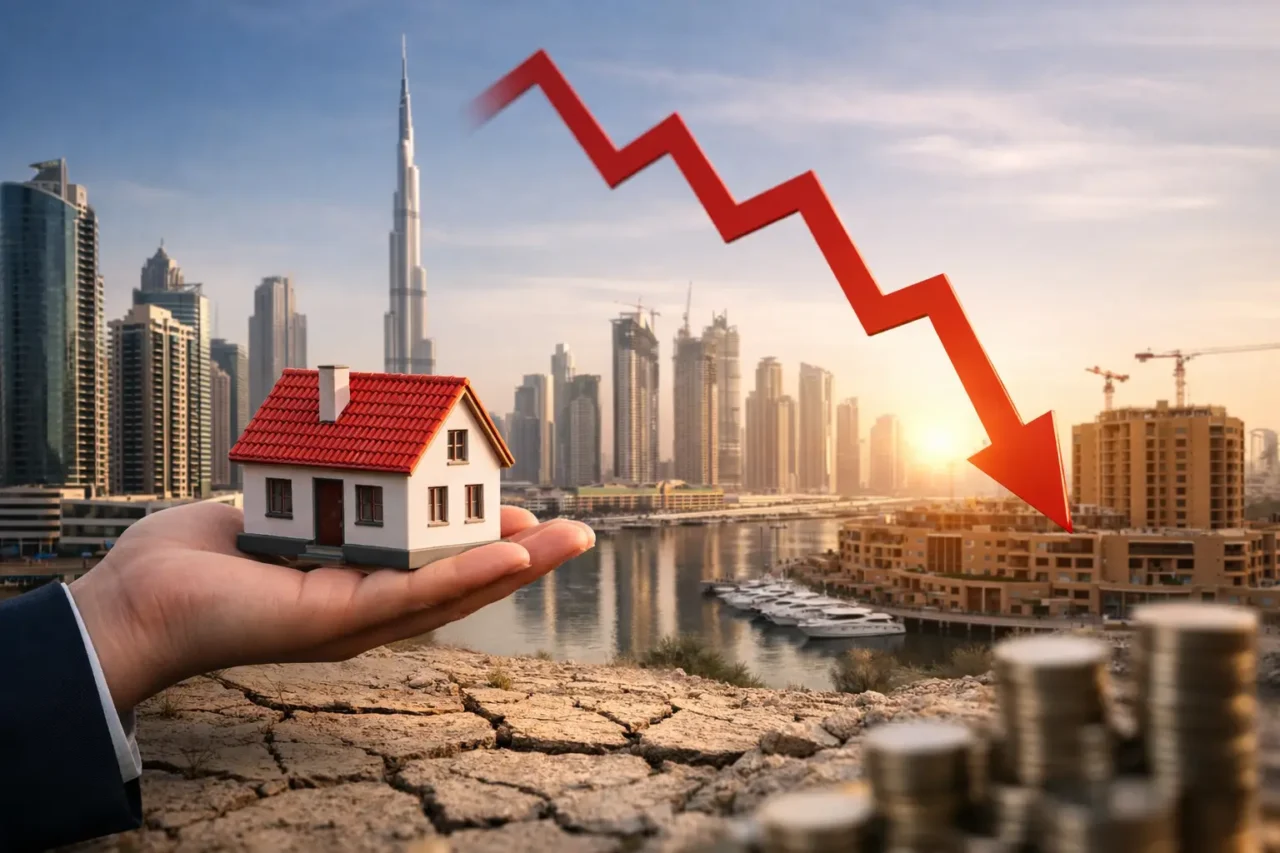
The question, is Dubai property market going to crash, usually comes up when prices rise quickly, off-plan launches accelerate, and more investors enter the market in a short period. It is a reasonable question, but it needs a measured answer. A market correction, slower growth phase, or localized price pressure is not the same as a full market crash, and in Dubai that distinction matters.
For investors who want a clearer view of the market before making a decision, I, Siraj Sultanli, Real Estate Investment Advisor in Dubai at fäm Properties, RERA License No. 93112, provide advisory support based on property type, location, entry timing, and overall investment objectives. This is especially useful for buyers comparing off-plan and ready properties or assessing whether current pricing still offers room for growth.
Is Dubai Property Market Going to Crash or Slow Down?
In most cases, investors use the word crash to describe any future decline in prices. In reality, property markets move in cycles. Some areas overheat, some stabilize, and some continue rising because demand remains stronger than supply in that specific segment. Dubai is not one single market. It is a collection of micro-markets shaped by community, developer, unit type, handover pipeline, and end-user demand.
That is why a broad statement rarely helps. Prime waterfront apartments, family villas in established communities, short-term rental stock in tourism-driven locations, and lower-quality speculative inventory do not behave the same way. One segment can flatten while another continues to perform well.
A true crash usually involves sharp and widespread price declines, major distress selling, weak transaction confidence, and a breakdown in demand across the market. That is a much higher threshold than a period of moderation.
What Usually Causes a Property Market Crash?
To assess whether Dubai could face a crash, it helps to look at what generally creates one. Property markets tend to fall hard when they are built on excessive leverage, weak end-user demand, unrealistic pricing, and supply that cannot be absorbed. They also become vulnerable when investor confidence disappears quickly or when the broader economy enters severe stress.
Dubai today has some risk factors, as every active market does, but it also has structural supports that make the discussion more nuanced. Transaction activity has remained visible across ready and off-plan segments, population growth has supported housing demand, and the city continues attracting business owners, professionals, and international capital. These factors do not eliminate downside risk, but they do reduce the likelihood of a sudden market-wide collapse without a larger trigger.
The Demand Side Still Matters More Than Headlines
One reason many investors keep asking whether Dubai will crash is that headline price growth can look aggressive. However, price growth alone does not prove that a market is about to fail. What matters is whether demand is broad, sustainable, and supported by actual users and long-term buyers rather than short-term speculation only.
Dubai has continued to attract residents, entrepreneurs, and globally mobile investors. This has supported both the sales and rental markets. Strong rental conditions also matter because they give many investors a real income case for holding property rather than relying only on resale gains.
According to market activity commonly tracked through DXB Interact, transaction volumes and new project launches have remained central to the current market cycle. That does not mean every project is a good investment. It means buyers need to separate genuine demand-led areas from locations where launch momentum may be stronger than long-term resale depth.
Supply Is the Main Risk Investors Should Watch
If there is one area that deserves close attention, it is future supply. A market does not need to crash for investors to underperform. In many cases, the real issue is buying into an area where too many similar units are scheduled for handover at the same time.
This is particularly important in off-plan investing. An off-plan property can still make sense when the developer is strong, the payment structure is practical, the location has depth, and the future supply pipeline is manageable. But if buyers enter a project based only on launch marketing, without studying surrounding inventory and handover timing, they can face resale pressure later.
This is where area-level analysis matters more than broad market opinions. A well-located project with differentiated demand may perform very differently from a similar-looking project in an oversupplied pocket.
Where pressure can appear first
Price pressure usually appears first in segments with too many comparable listings, weaker developer quality, investor-heavy ownership, or limited end-user appeal. Smaller units in heavily marketed areas can sometimes face this issue sooner than family homes in communities with stronger occupancy demand.
That does not mean apartments are unsafe or villas are always better. It means investors should evaluate supply concentration, tenant depth, and resale competition before committing capital.
Why Dubai Today Is Different From Simpler Crash Narratives
Some investors compare every strong market cycle in Dubai to past downturns. While historical awareness is useful, simple comparisons can be misleading. The current market has different drivers, stronger digital transaction systems, a more mature developer landscape, and better access to market transparency than many buyers had in earlier periods.
Official ecosystems such as the Dubai Land Department, RERA, and Dubai REST have improved visibility around transactions, ownership processes, and project-related checks. That does not remove investment risk, but it does help serious buyers make better-informed decisions.
Another difference is investor profile. Dubai still includes short-term and speculative capital, but it also attracts business-led migration, relocation-driven buyers, and long-term wealth allocation. Markets with a broader buyer base are generally more resilient than markets driven by one type of participant only.
So, Is Dubai Property Market Going to Crash in 2026?
A more realistic answer is that a broad crash is not the base-case view, but selective corrections remain possible. Some communities may stabilize. Some projects may underperform. Some overvalued units may need price adjustments. That is very different from saying the entire market is about to collapse.
For most investors, the more useful question is not whether all of Dubai will crash. It is whether the specific asset they are considering has enough support from location, demand, developer quality, and pricing logic.
If you buy into a proven area with healthy absorption, practical unit sizing, and a reasonable entry price, the risk profile is different from buying into a crowded speculative launch. The Dubai market often rewards selectivity more than speed.
What Smart Investors Should Focus on Instead of Crash Predictions
Trying to time the entire market perfectly is rarely the best strategy. Professional investors usually focus on risk-adjusted entry, asset quality, and holding power. In Dubai, that means paying attention to a few core points:
- Location strength – not just popularity, but rental demand, resale liquidity, and long-term neighborhood depth.
- Developer credibility – especially for off-plan purchases where execution quality and delivery matter.
- Supply pipeline – how many similar units are expected in the same area and timeframe.
- Price discipline – whether current pricing is supported by market evidence rather than launch momentum.
- Investment objective – capital growth, rental income, end use, or portfolio diversification.
When investors skip these basics, they often blame the market later for what was really a poor asset-selection decision.
The Real Risk Is Buying Without Strategy
Dubai can be an attractive market, but it is not a market where every project, every area, and every launch performs equally. The biggest mistake is not buying before a crash or after a crash. The biggest mistake is buying without a framework.
That framework should include transaction data, area comparison, supply review, legal process clarity, and a realistic hold period. It should also reflect whether the property is being bought for yield, appreciation, personal use, or a future exit after handover.
Investors who approach Dubai with that level of discipline are usually asking better questions. Instead of asking only whether prices will fall, they ask which submarkets are still undervalued, which developers are delivering consistently, and which unit types are most exposed to future competition.
Professional Advisory Services
Dubai is not risk-free, and no credible advisor should present it that way. But a market having risks does not automatically mean it is heading for a crash. It means investors need sharper selection standards and professional advisory.
If you are considering making a real estate investment in Dubai and want to assess whether a specific area or project fits your goals, I, Siraj Sultanli, can help you evaluate the opportunity from an investment, legal, and market-positioning perspective before you move forward.